
Name of Monument: Baltit Fort
Location: Karimabad
Period of Construction: 13th century
Materials of construction: Stone, wood and mud mortar
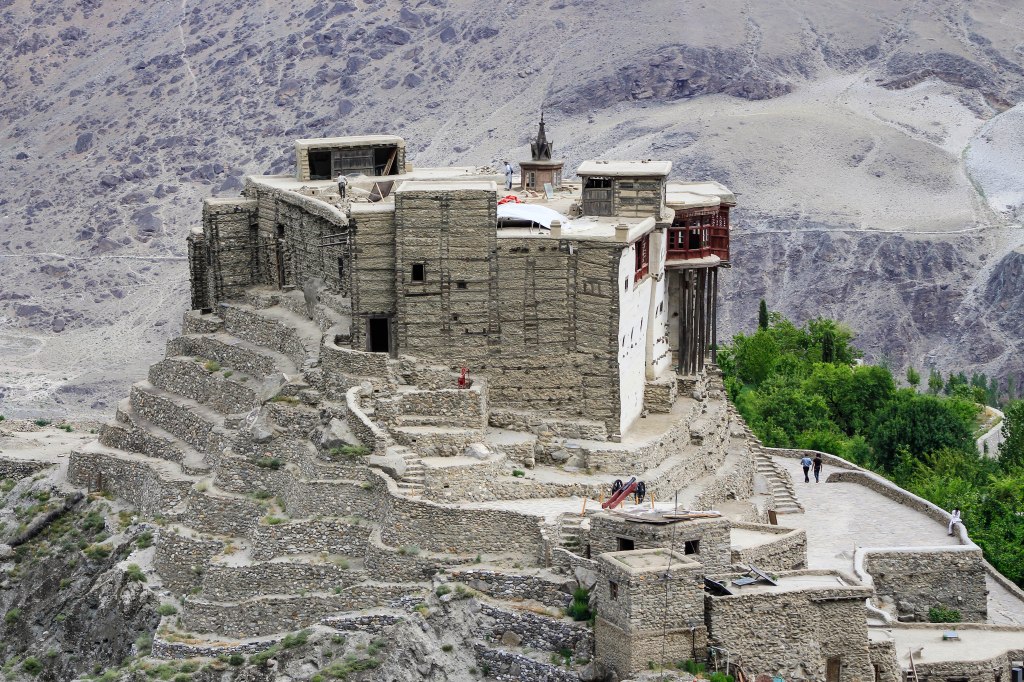
Baltit Fort is located in Karimabad, which was once the capital of the state of Hunza in the province of Gilgit-Baltistan. It is the most prominent landmark in northern Pakistan. The fort is situated on a flattened spur below the Ulter Glacier, strategically positioned to overlook the Hunza Valley and control the seasonal trans-Karakoram trade between south and Central Asia. It stands as a testament to the architectural ingenuity of cribbage construction, designed to withstand earthquakes. The foundation of the fort dates back to the 8th century, although the structure itself has undergone many additions and modifications over the years. The original construction of the fort started around 8th century A.D but the carbon dating indicates most of these additions were made in the 13th century.
The Baltit Fort has a rectangular floor plan and consists of three floors, elevated on a high stone plinth. The ground floor primarily serves as storage chambers, while the first floor features an open hall. A staircase leads to the second floor, which was predominantly used during the winter months and includes an audience hall, guest room, dining hall, kitchen, and servant quarters. Another staircase leads to the third floor, partially exposed to the elements, housing the summer dining room, audience chamber, bedroom, and reception hall.
Until 1945, the fort was inhabited by the Mir, or ruler of Hunza. During the conservation work conducted in 1990, it was revealed that the core of the structure—a single defensive tower made of timber and stone—was built in the eighth century A.D. Over time, additional towers were added and connected by a one-story construction featuring small rooms and sub-surface storage chambers. The complex was further expanded with the addition of a second and third floor. To enhance stability in an area prone to seismic activity, the stone walls of the fort were reinforced with a traditional internal framework of timber.
One of the major challenges faced during the conservation efforts was the steep surroundings of the fort, which posed a threat to its stability during strong winds.
Regenerate response
 Naqoosh-e-Javidan