
Name of the Monument: Garden of Hasan Abdal commonly known as Wah garden
Location: Hasan Abdal
Period of Construction: Akbar to Aurangzeb
Material and method of construction: Bricks, Black Taxila stone, Red sandstone
Brief Description:
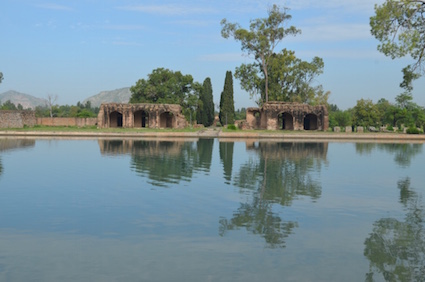
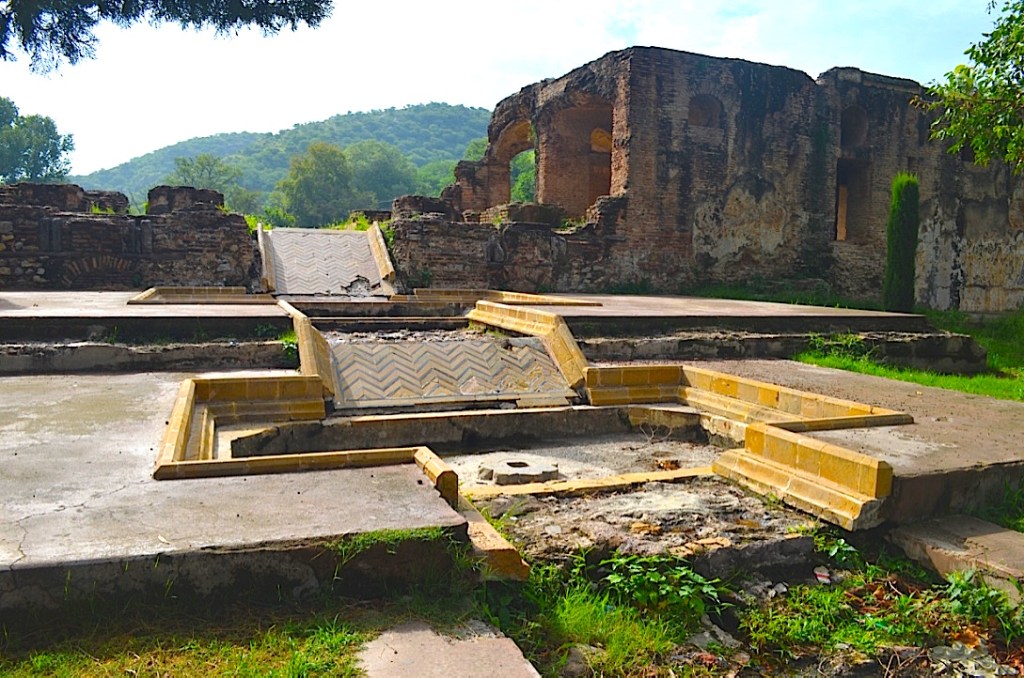
The present garden of Hasan Abdal popularly known as Wah Garden to larger degree belongs to Shah Jahan period. In 1581 AD, when Akbar laid the foundation of Attock Fort, he appointed Raja Man Singh to remain at the fort to protect the northwest frontier. At this time, Raja Man Singh founded the garden of Hasan Abdal, which was comprised of two terraces. On the upper terrace he built a large tank, with a water channel leading to lower terrace and a baradari. Jahangir changed the whole character of the landscape. He provided funds twice for the garden’s expansion: the first time on 17 Ramaḍān 1018 AH, he sent four thousand rupees from Lahore. The second time, in Shawwāl 1018 AD, he sent five thousand rupees. These funds paid for a number of additions, including a large bathhouse south of the baradari, a central canal, and fountains. He added a hammām and improved the tank and water system. His interest in the garden may be judged from the fact that the baradari he commissioned was decorated with frescoes.
Sometime around 1645 AD, Ustad Ahmad Mimar was summoned by the governor of Punjab to make additions and alterations to the existing layout and design Sarai at Hasanabdal. He seems to have designed and built two baradaris and raised the level of the terrace and the tank. At the same time, the fountain channel was tessellated and a zanana (ladies’) garden was added. Aurangzeb stayed there for almost a year and a half, from 26 June 1674 AD to 23 December 1675 AD, during which the garden served as the capital for the Mughal empire. He added a farudgah (resthouse) on the east side. Both court historians and European travelers praised its beauty; Salih Kambo called it Bāgh-i gulistān-i Iram (the rose garden of Iram).30 The natural landscape setting, continuous flow of water in the pool and channels and humble structures made it one of the finest heart-pleasing gardens of the Mughals.



 Naqoosh-e-Javidan