
Name of Monument: Gori jo Mandar
Location: Gori Village, Tharparkar
Date of Construction: c.15th Century

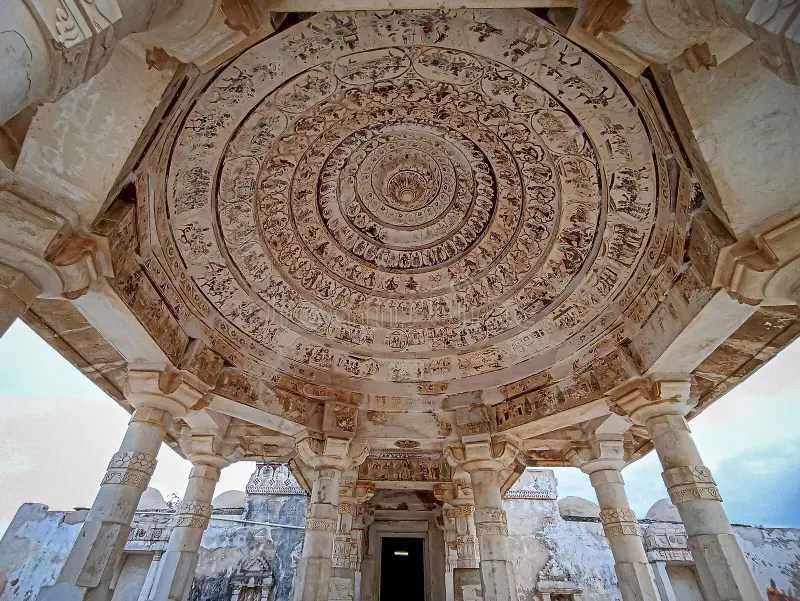
The Gori temple is located in the village of Gori in Tharparkar district in Sindh and largest in terms of its size measuring 125’ by 50’. It was believed to have been built in late fourteenth century. The temple complex have four compartments including porch. The final compartment known as cella enshrined the deity. These compartments except porch are enclosed by means of 27 cells facing inward. The temple was planned on the north south axis where porch is located on the north and serves as entrance to the shrine. It is open on three sides which the fourth or south side face the shrine or cella. The main shrine was covered with shikara but rest of the chambers have domical roof. The shikara is now badly damaged as result of the gunfire to capture the hidden soda chief. The domical roof over the porch rests on lintel which finally transfer load on twelve columns four on each side.

The architectural details of a typical column is very much similar to other Rajasthani temples where columns have square base, the shaft square at the lower part, octagonal in the middle and circular up to the capital. The capitals have voluted brackets protrude on all four sides of the capital. The lintel is plain that takes the load of the dome built on overlapping rings. The dome finally crowned with inverted lotus but the finial is missing. There is a projected sloping eave on all four sides above which parapet contain merlons, a feature came from Muslim tradition. The soffit of the dome is highly ornate with fresco paintings depicting various cultural scenes as well as male and female figures wearing traditional local dresses.
The porch is connected with internal part of the complex through a cloister. Its flat roof is supported on six column, three on each east and west sides. The next pillared hall is largest in size (33’-4’’ by 31’-4”) is again covered with a corbelled dome. The central dome in the middle is the largest dome in the complex while smaller dome supported on columns encircle around it. The next space is mandapa (11’-7” by 10’) have offset in the wall creating niches on east and west side. It is also covered with dome. Every surface of the pillared hall including white marble pillars, is elaborated with sculpture forms and fresco paintings. The final graba griha or cella is connected with mandapa with narrow passage. This room is again has offsets in the wall on all four sides. The cella once covered with beautiful Kathiwar style shikara which is surrounded by small domes.
 Naqoosh-e-Javidan