
Name of Site: Gurdwara Punja Sahib
Location: Hasan Abdal
Date of Construction:
The Gurdwara Punja Sahib is located in Hasan Abdal. It was built in the memory of Guru Nanak visit to the site along with Bhai Mardana in the month of Baisakh Samawat 1578 B.K corresponding to 1521 AD. Under the shady cool tree, Guru Nanak Mardana started reciting kirtan and their devotees gathered around him. According to legend, which is not mentioned in any historical source, Bhai Mardana was sent three times to Shah Wali Qandhari by Guru Nanak so that he would provide some water to quench his thirst. Wali Qandhari refused his request and was refused his request and was rude to him. In spite of this, Mardana still very politely stuck to his demand. The Wali remarked; “why do not ask your Master whom you serve.”
Mardana ji went back to Guru in a miserable state and said, “Oh lord I preferred death to thirst but will not approach Wali the egoist.” The Guru replied “Oh bhai Mardana ji! Repeat the name of God, the Almighty and drink the water to your heart’s content.” The Wali Qandhari rolled a stone towards them. The Guru put aside a big rock lying nearby and a pure fountain of water spreading up and began to flow endlessly. The rock with hand impression of Guru Nanak is still preserved on the site. Bhai Mardani quenched his thirst and felt grateful to the Guru. This is why the site was named as Punja Sahib.

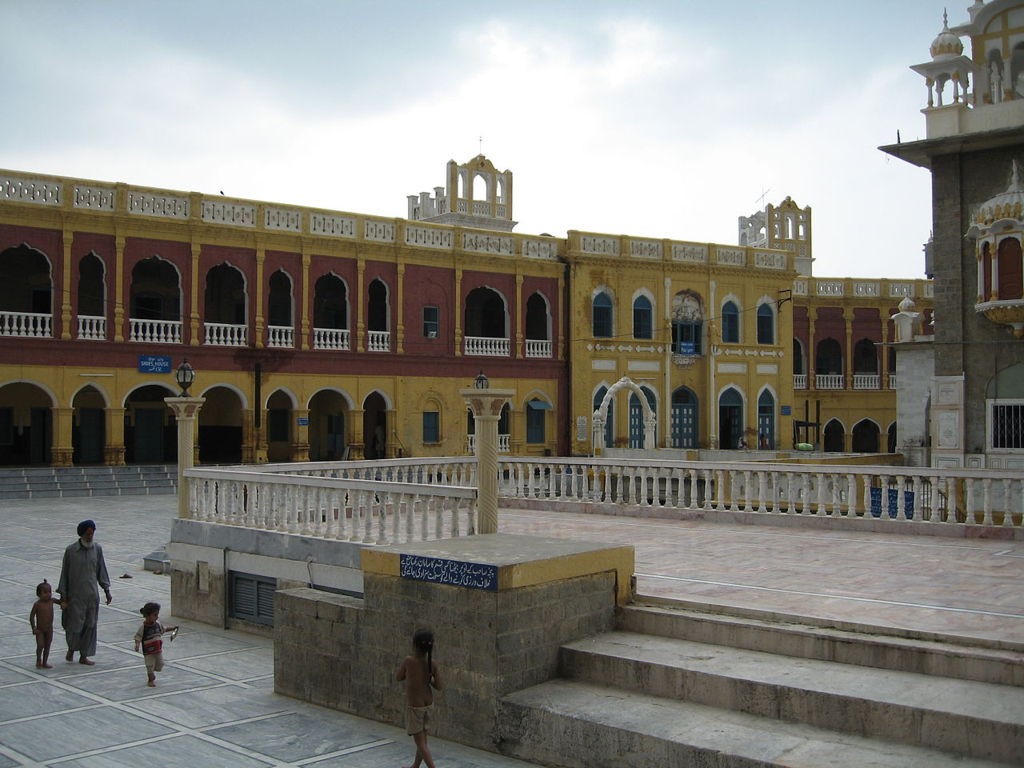
A Gurdwara was built on the site The gurdwara is located in the middle of quadrangle. It contained gurdwara, a pool, a kitchen for langar, and double storied high building for the accommodation of pilgrims visiting from faraway places. There is a large pool for the ashnan. Next to the pool, on an elevated platform, stands a beautiful large gurdwara built in the Mughal style by Maharaja Ranjit Singh (1780-1839). The gurdwara houses the Guru Granth Sahib- the holy book of Sikhs. The foundation of the beautiful three-storey building, designed after the samadh of Maharaja Ranjit Singh in Lahore, was laid on 14th October 1932 by five eminent holy men, Panj Piare. Built with grey sandstone, its exterior is spotted with protruding domed bay windows. The central fluted dome is surrounded by several symmetrically placed big and small domed kiosks. Unlike the Maharaja’s samadh in Lahore, it has porches covering entrances to the sanctum which stands within the sarovar that receives water gushing forth from around the rock bearing the sacred Parija Sahib or the palm-imprint of the Guru. Several other buildings for staff and pilgrims and other, ancillaries were added subsequently. A large double storied hostel for the pilgrims surrounds the courtyard, the pool and the gurdwara.
 Naqoosh-e-Javidan