
Name of monument: Qila Rohtas
Location: Dina
Date of Construction: 1541
Rohtas fort, one of the most splendid forts of Pakistan, is located near Dina city. The construction of the project was commissioned by Sher Shah Suri, founder of the Sur Empire, to stop the advancing Mughal emperor Humayun who had been exiled to Persia after his defeat at the Battle of Kannauj. He wanted to return from Khyber Pass. Therefore, the fort was built upon a strategic location between Kabul and the plains of Punjab to stop the Mughal emperor returning to India. Raja Todar Mal, the minister of the Afghan king Sher Shah Suri, was entrusted the job the construction of the fort.
According to Makhzan e Afghani, “Sher Shah issued farmans to complete the fortification of Rohtas, but Toder Kotehri is said to have represented that the kakers (khokhers) to whom that country belonged, entered such an aversion to work for wages, that they had agreed among themselves, upon oath, to expatriate every person that should act contrary to it. Sher Shah, in answer flatly told him, “That he should no way be allowed to give up that work, which he only wished to do in consequence of his greediness for gold.” Todar on the reception of this fresh command, fixed first golden ashrafi as the price of one stone, which paramount sum induced the kakers flock to him, afterwards a stone was paid with a rupee, and this pay finally fell to five tankas, thus the fortress was completed.”
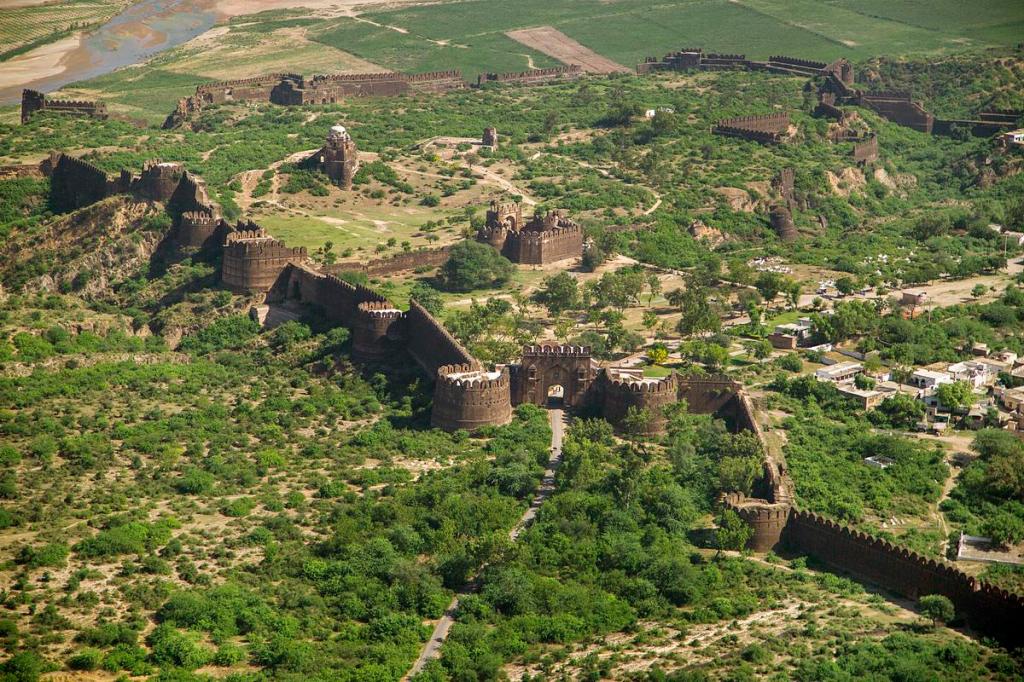
Rohtas Fort encloses an area of 170 acres by 2.5 miles of walls supported by bastions, towers and twelve monumental entry gates. The walls are 35 feet to 40 feet high. The fort is an irregularly shaped triangle and follows the contours of the terrain. The northwest corner of the fort is walled off from the rest of the structure by a 1,749 ft long wall. The fortification wall up to three terraces at different levels, connected by staircases. The uppermost terrace has merlons from which soldiers could fire muskets and pour molten lead. In addition, the fort has hundreds of machicolations, each beautifully decorated with geometric patterns. The small outlets permit soldiers to pour molten lead or other hot liquids on invaders trying to scale the fort’s walls.
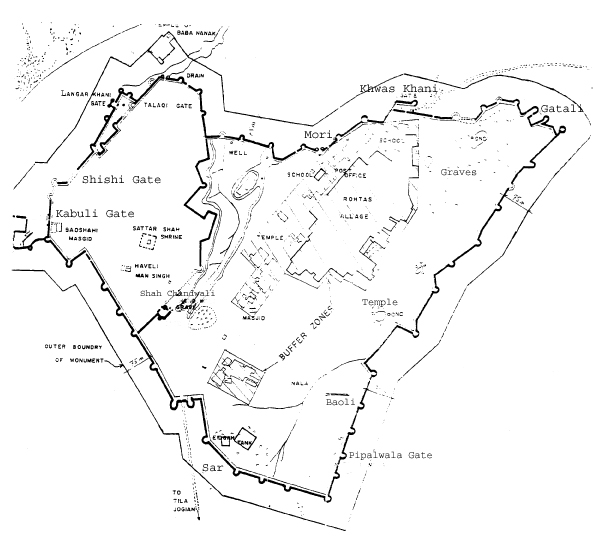
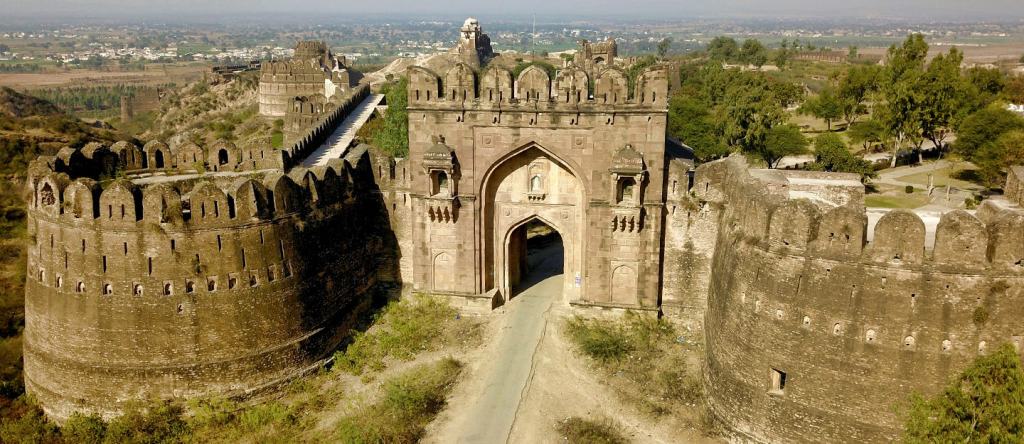
Rohtas Fort has 14 gates built of grey ashlar stone. All these gates are architectural monuments in their own right. Sohail gate features some of the best masonry work of the Suri empire and was likely the ceremonial main entrance to the fort. This rectangular gate measures 70.0 feet high by 68.0 feet wide, and with a depth of 49 feet. Its central archway is 15.5 feet wide and maintains its shape throughout the depth of the gate. The gateway has ornamental floral motifs with richer decorations on its outer face. There are seven battlements along the outer face of the Sohail gate. A large hall, on the upper level now serves as museum,
Shah Chandwali is a double gate that links the citadel to the main fort. It is 44 ft wide and 27.0 ft deep. The inner gate is a simple archway12.0 ft wide. Kabuli gate opens to the northwest in the general direction of Kabul, Afghanistan. The gate may have been built in two stages. It consists of an inner and outer gate and enclose a beautiful stepwell. Its opening is10.3 feet wide and is flanked by two bastions on either side. The gate has five battlements on top, with stairs leading up
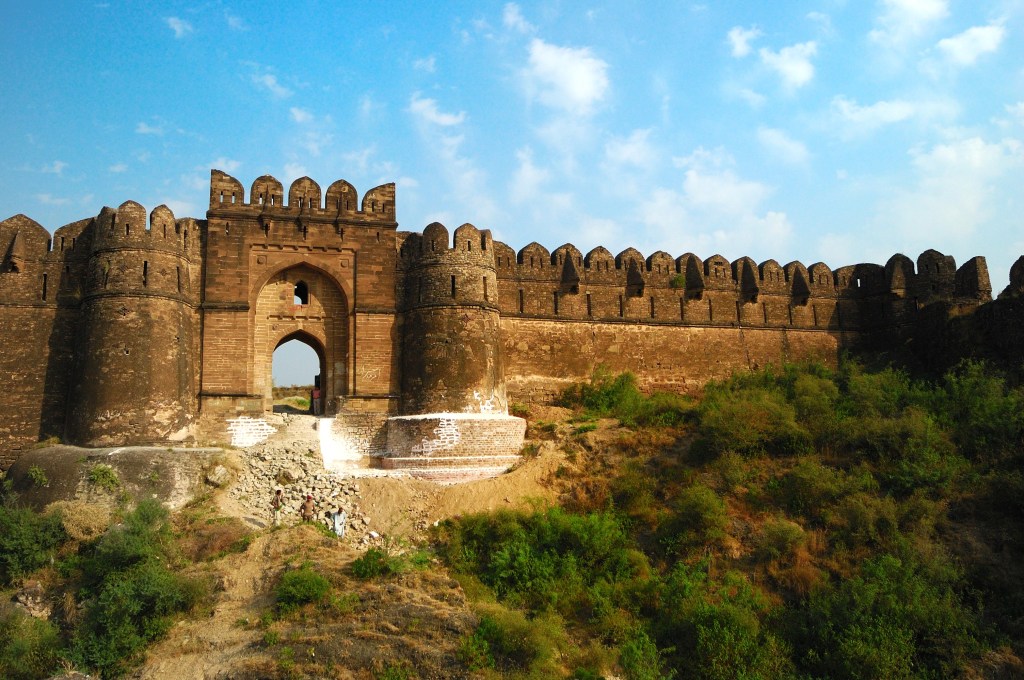
the outside wall. Shishi gate derives its name from the glazed tiles that decorate its outer arch. These blue tiles are the earliest known examples of this technique. A carved calligraphy inscription to the left of the gate gives the date of construction of the fort. The Persian inscription says:
In the Hijri year 948 (1541 AD) came the exalted
At that time constructed the great fort
The emperor is Sher, with life long
There is no match to his good fortune.
It was completed by Shahu Sultan.
Langar Khani gate opens directly into the citadel but was designed as a trap in the direct line of fire from the fort’s bastions. It is a double gate with a central arched opening that is 11 feet wide and 50.0 feet high. The outer arch has a small window like Sohail Gate. The external opening leads to a Langar Khana (kitchen). Talaqi gate has two bastions on each side. It is 45 ft wide and 50.0 ft high. This gate features a duplicate of the carved calligraphy inscription on Shishi gate. The origin of the name Talaqi is unknown. The Mori gate faces towards Kashmir on the north. Therefore, it is also called Kashmiri gate. Mori gate opens into one chamber, which opens into another. Khwas Khani is another important double gate named after one of Sher Shah Suri’s greatest generals, Khawas Khan. The gate with bend entrance provides main access to the fort from the Grand Trunk Road. The outer gate is 42 feet wide and 26 feet deep. The outer gate has a bastion, five battlements at its top, and flanking defensive walls with cannons.
The inner and outer gates are almost mirrored images. The inner side of Khwas Khani also has five battlements, making it unique amongst the fort’s inner gates. The inner and outer arches have calligraphy inscriptions and sunflower motifs like Sohail gate. The inner gate also has a room with windows that open to the inside and the outside. It is accessible by only one gate and has a fine stepwell, suggesting it was for the royal family. Gatali is a single gate that is 30.0 ft high and 20 ft deep. It faces the village Gatali ford, also called Patan Gatiali or Gatiyalian. Sar is a small entrance that seems to have been made by locals knocking down the main wall (outer boundary) as a passage to the adjacent jungle. There is a bastion next to this gate. Because the now dilapidated pond in front of this gate has existed since the fort’s beginning, the entrance is called Sar gate (water pond). Tulla Mori and Pippli are entrances rather than gates. Tulla Mori is on the eastern side of the fort and has an adjacent bastion. It is 6.6 ft wide. Pippli is 7.0 ft wide.
Royal mosque
The small Shahi Masjid (Royal Mosque) is near the Kabuli gate and is the most decorated of the fort’s original buildings. The mosque has three bay prayer chamber and a small courtyard. Stairs leads from the courtyard to the top of the Kabuli gate. The western wall of the mosque is attached to the fortification wall.
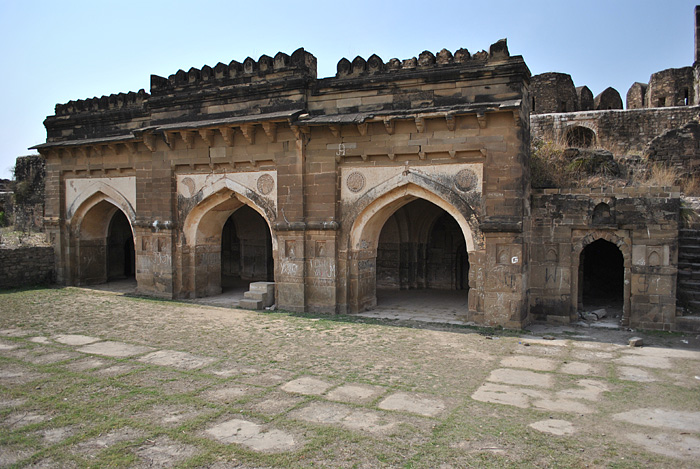

The prayer chamber is 63 ft long and 24 ft deep. It has three bays with a low-pitched dome ceiling. The Pesh Imam (prayer leader) had a small room at the end of the prayer chamber. This room has a small interior domed roof. The mosque has decorative stone carvings featuring a sunflower motif and calligraphy engravings. One such carving features the word “Allah” in Arabic calligraphy. The merlon on top of the Shahi Mosque have the same carving. The sunflower motifs are on either side of spandrel of arches. There are round carvings of the kalima tayyiba in Naskh script, surrounded by lilies, on the mosque’s outer wall.
Raja Man Singh Haveli
The Raja Man Singh Haveli, located on the highest point of the citadel, is the fort’s only palace. The Rani Mahal (Queen’s palace) is a one-story structure inside the fort. It originally had four rooms, but only one room remains today. The room is 8.0 by 8.0 ft square. It is 20 ft high and beautifully decorated inside and outside. The inside of the roof has decorative flowers, geometrical patterns, and fake windows. The stone dome roof is carved on the exterior to resemble a flower.
Stepwells
There are three baolis or stepwells in the fort, made by cutting deep into the limestone. The central baoli is in the middle of the fort and served soldiers, elephants, and horses. This baoli has 148 steps. Each step is 8 in wide. Three arches span its length. The royal baoli is near the Kabuli gate. It has 60 steps and small chambers used as baths by the royal family. The Sar gate baoli, located near the Sar gate, is smaller and was most likely used by soldiers. All these baolis differ in design but the one located near the Kabuli gate is most exquisite.

Rohtas Fort is included in the World Heritage List.
 Naqoosh-e-Javidan