
Location: Multan
Province: Punjab
Period of Construction: Tughluq: 1320-1324
Materials of Construction: Fair face brickwork and glazed tiles

The tomb of Shah Rukn-i-Alam was built by the Tughluq ruler of Delhi Sultanate, Ghiath-ud-Din (r. 1320-1325), for himself, it was presented to the family of the renowned Sufi saint following the latter’s death. The three-tier structure stands within its own compound at the northwestern edge of the Multan Fort. The mausoleum is said to have been the first octagonal tomb built in the subcontinent and the second largest dome in the world after Gol Gumbad in Bijapur, India.

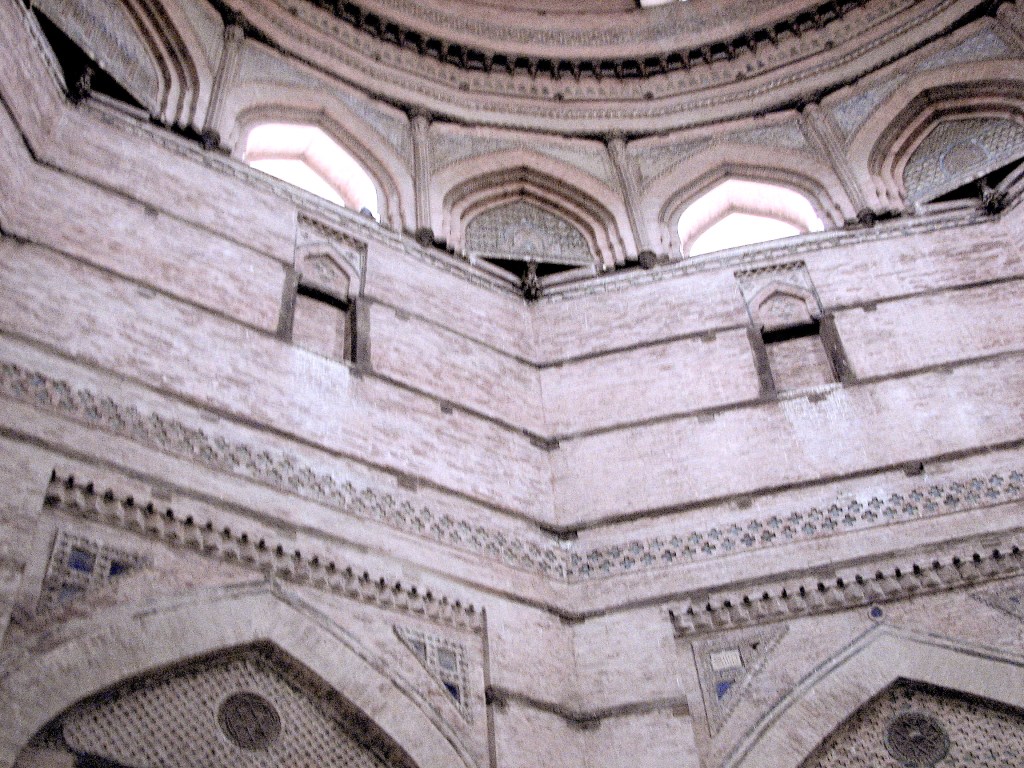
The tomb is built in three levels with an octagonal lower story, an octagonal upper level of smaller dimensions, and a crowing white squatter dome. The plain brick wall is decorated with a frieze of zangira pattern. Intricate floral carvings and Quranic inscriptions including the Ayat al-Kursi, are carved on wooden bands decorating the mihrab. The carved wooden mihrab is though to represent the earliest example of its category. The upper level, accessible via staircase, is ringed by wide open space surrounded by a parapet wall decorated with mudakhil pattern. The first storey support a hemispherical dome is highly ornate decorated with geometric, floral and arabesque designs and calligraphic motifs inspired from Central Asian and Persian tradition. The exterior is further ornamented with the use of carved brick and wood as well as blue and white faience mosaic tiles with raised relief patterns, interlocking stars, and hexagons rendered with dark blue, azure and white, glazed tiles floral tile panels, carved terracotta and string courses.
 Naqoosh-e-Javidan