
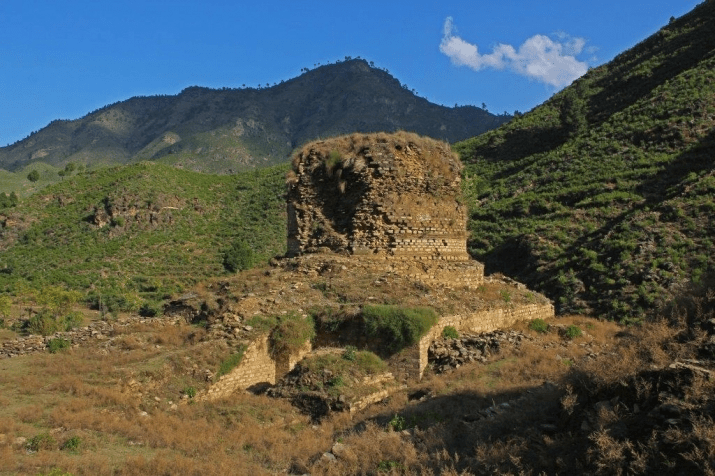
Name of Monument: Takar Dara Stupa
Location: Barikot
Date of Construction: 1st-3rd Century AD
The Buddhist site of Tokar-dara (Najigram) is situated about 5 km on the south of Barikot on the way to Karakar pass. The site consists of a large stupa, the associated monastery, living quarters, assembly hall, and an aqueduct cave, two other stupas badly damaged and several unidentified remains. The Large Stupa is probably the best preserved in this area. The stupa forms part of a Buddhist complex boasting numerous monuments, including a monastery, an assembly hall, a cave, an aqueduct and residential settlements. The stupa consists of a hemispherical dome, upper and lower drums resting on a square podium. The main stupa was surrounded by the votive stupas which have been destroyed by unauthorized diggers. Some traces of the votive stupa can still be seen. The stupa court is 105 feet long from south north and 236 feet east-west, fortified by a wall.
The stupa has four columns like the one at Saidu Sharif, and a central
gigantic niche akin to the stupa at Amlukdara. The recent study indicate that the stupa was probably abandoned sometime between the 4th and 6th century.
It was constructed between the 1st and the 3rd century AD when Buddhism held sway in the region. All are of great historical significance within the Buddhist history of the region. The establishment here is an excellent amalgam of nature and architecture. The ruins have withstood the test of time and seem to have created a close link with the landscape as an ancient fixture. The stupa court is 105 feet long from south north and 236 feet east-west, fortified by a wall. The main stupa was surrounded by votive stupas that have been completely destroyed by
unauthorized diggers. Faint traces of these votive stupas can still be seen.


 Naqoosh-e-Javidan