
Name of monument: Maqbara/Rauza Asaf Khan
Location: Shahdara, Lahore
Date of Construction:
Materials of Construction and finishes: Brick walls, (red sandstone, marble), glzed tiles
Brief Description:
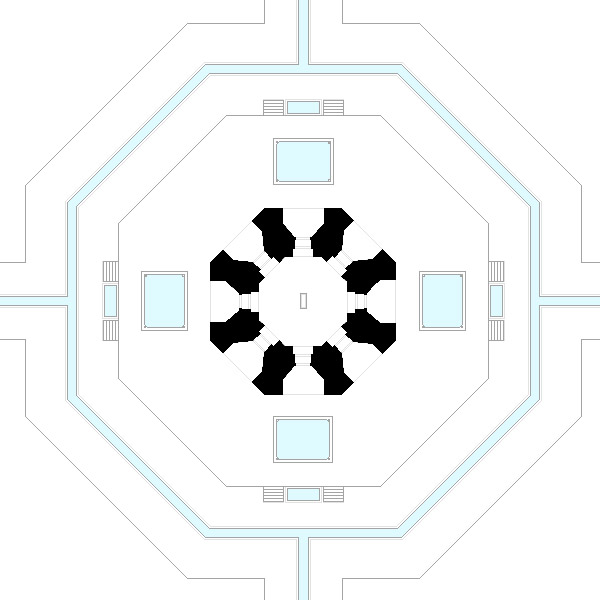
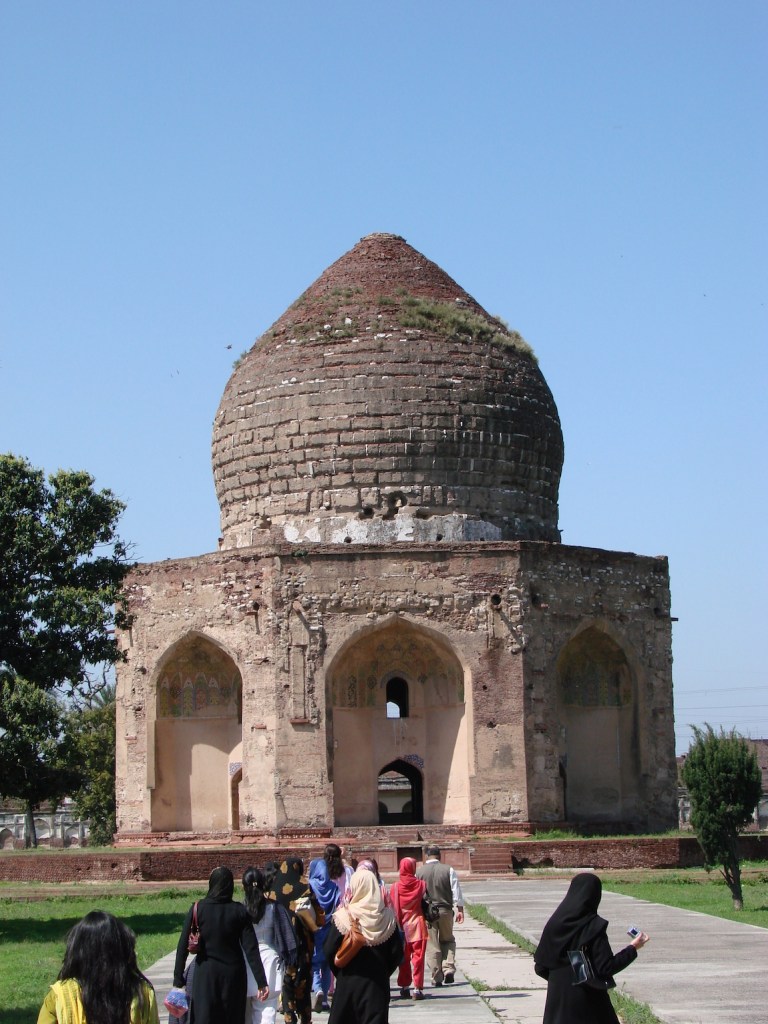
The tomb of Mirza Abul Hasan Asaf Khan (father-in-law of Shah Jahan) was commissioned by Shah Jahan following Asif Khan’s death in 1641 AD. According to Abdul Hamid Lahori author of the Padshahnama, the shrine was under construction for 4 years until 1645 AD at a cost of 300,000 rupees. The tomb is an octagonal structure with a high bulbous dome stands in the center of a vast garden 300 feet square divided into four squares once set with reservoirs, fountains and pathways. The reservoirs were planned in cardinal directions on 3 feet 9 inches high podium. The tomb has eight entrances set in high pishtaqs. The tomb measures 38 feet 8 inches on each side. The exterior was originally adorned with rich red sandstone with marble inlay work. The high bulbous double dome was originally covered with marble veneering. The stone clad over the facades was plundered during the Sikh period. The tomb chamber is double height while a circumambulation gallery is created at the first floor within the thickness of the wall. The tomb has a white marble cenotaph inscribed with ninety-nine name of Allah. The gallery also has openings in the tomb as well as in pishtaqs.

The interior was decorated with very bold stucco tracery. The important feature of the tomb is use of Kashi Kari is qalib design, a feature for the first time used in Lahore along with mosque of Dai Anga. In addition, the inner walls of pishtaqs were decorated with cuerda seca tiles, a feature used for the first time in any Mughal empire. The color palette in the tomb of Asaf Khan has shifted compared to Jahangir’s tomb, with the formerly dominant blue yielding mainly to orange and yellow with some black white and green also occasionally used as a ground. The floral designs are completely symmetrical. The palette was chosen to match the cuerda seca tiles on the inner walls of pishtaqs. They all have a yellow ground, with mainly orange stems and flowers, also some green and dark blue is found too. The attempt to depict the upper and lower sides of the leaves is shown both in two shades of green and in dark blue and orange. Such tile work was frequently used in the Timurid and Safavid architecture.


 Naqoosh-e-Javidan