
Name of Monument: Maqbara Baha ul Halim
Location: Uchchh Sharif
Date of Construction: c. mid 14th century
Material and Method of Construction: Brick construction, Finished in Glazed tiles.
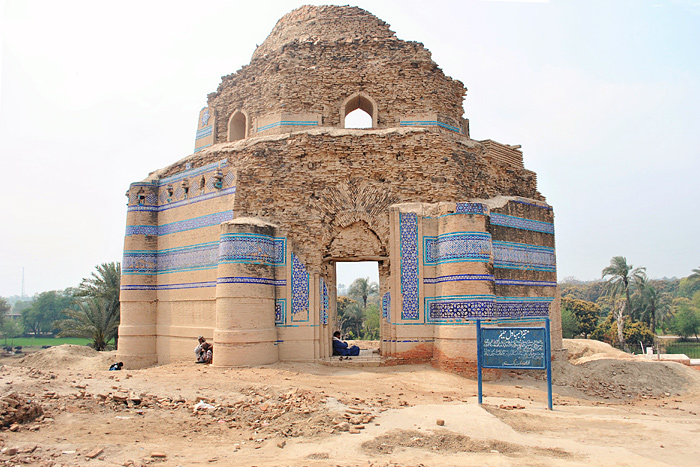
The tomb of Baha Ul-Haleem is the earliest of three domed mausolea found on a high mound in the town of Uch, a center of Sufism under the Delhi sultanate. Little is known about him, except that he was the teacher of the saint Jahaniyan Jahan Gasht, who built the mausoleum. The tomb shows the influence of the funerary style that originated around Multan, exemplified by the tomb of Bahauddin Zakaria.
The tomb is octagonal in plan. Externally each corner of the octagon is strengthened with upward sloping corner towers. At zone of transition or drum level, the octagonal plan is converted into sixteen-sided polygon in the interior and octagon in the exterior. The structure is finally covered with hemispherical dome. There are four arched opening on the ground floor. The main entrance was located on the eastern side. The arched openings are framed to make them prominent. The spandrel of arches and rectangular frames were finished with faience and faience mosaic. A frieze of of faience mosaic run continuously on top of the wall and below the zone of transition. The squinch arches are supported on wooden wall plates like the tomb of Baha ud Din Zakriya.
The external facade consisted of horizontal bands of faience mosaic revetment and fair face brickwork. The upper portion of the wall and corner towers carry four and three pigeonholes respectively. At first floor level each side of the octagon has an arched opening. The wall surfaces are treated with horizontal bands of faience mosaic. The upper portion of the wall also carry pigeonholes. The dome is finally finished with glazed tiles.

 Naqoosh-e-Javidan