
Name of Monument: Maqbara Khaliq Walid
Location: Village Khatti Chor, Tehsil Kabir Wala
Date of Construction: Late 12th century
Material and Method of Construction: Brick Masonry
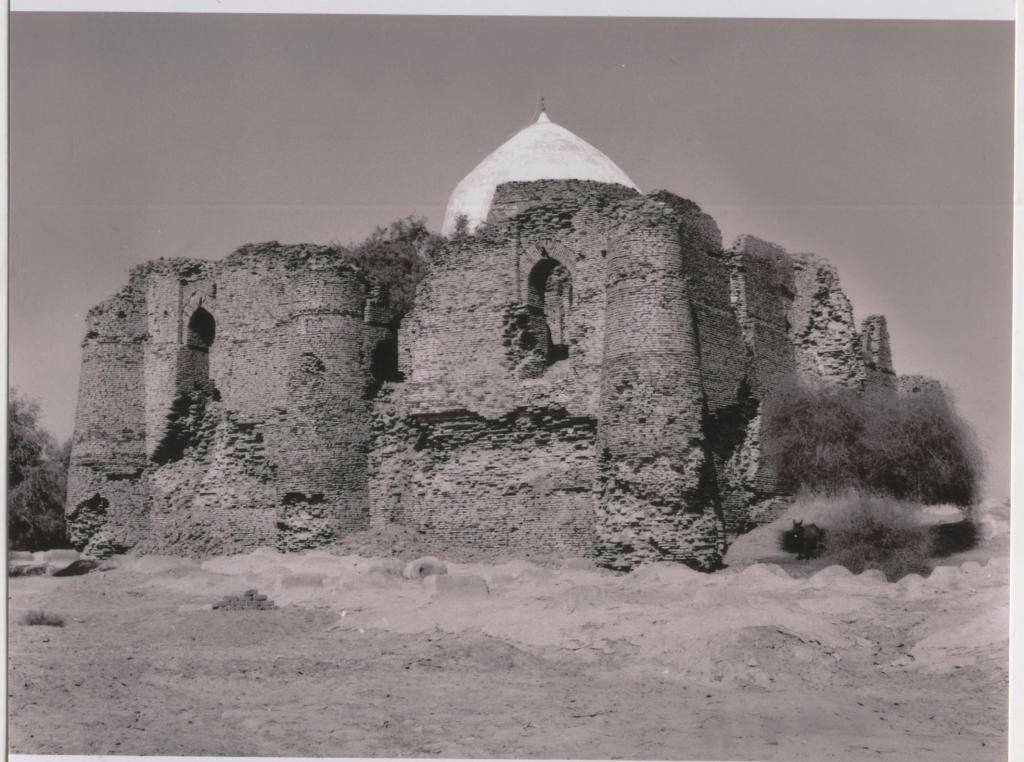
The tomb of Khalid Walid was built by the Ali bin Karmakh, a powerful Governor of Multan (1175-1186 A.D). According to local traditions the Saint is said to have come to Multan with armies of Sultan Mahmud of Ghazna and died here. The tomb occupies the center of fortified brick structure with round tapering towers at each corner of the square. It is considered to the oldest tomb in the northern areas of the Sub-continent The shrine assumes the form of a fortified rectangle measuring 70 by 90 feet, and is capped by a low and sloped dome, with an exterior made of plain brick and inward sloping walls that may derive from Seljuk architecture of Central Asia.

The most impressive part of the tomb is its mihrab, created as an elaborate arched recess in the center of the outer wall of the western gallery. The mihrab is sunk deep into the thickness of the wall with back solid projection, in the shape of a half dome erected after perfect mathematical calculations used by master architect. Its border and inside portions bear Qur’anic verses in Kufic script. The entire facing of the mihrab arch and major parts of its interior have been faced with cut and dressed-brick panels of different sizes and shapes; a double panel running on the sides and stop (now missing) are filled with Quranic verses devised in floriated Kufic characters within flat borders. Within this double frame, which is slightly recessed are square shaped pillarets flanking and supporting the main arch, whose shafts are faced with Quranic verses in cut bricks.


 Naqoosh-e-Javidan